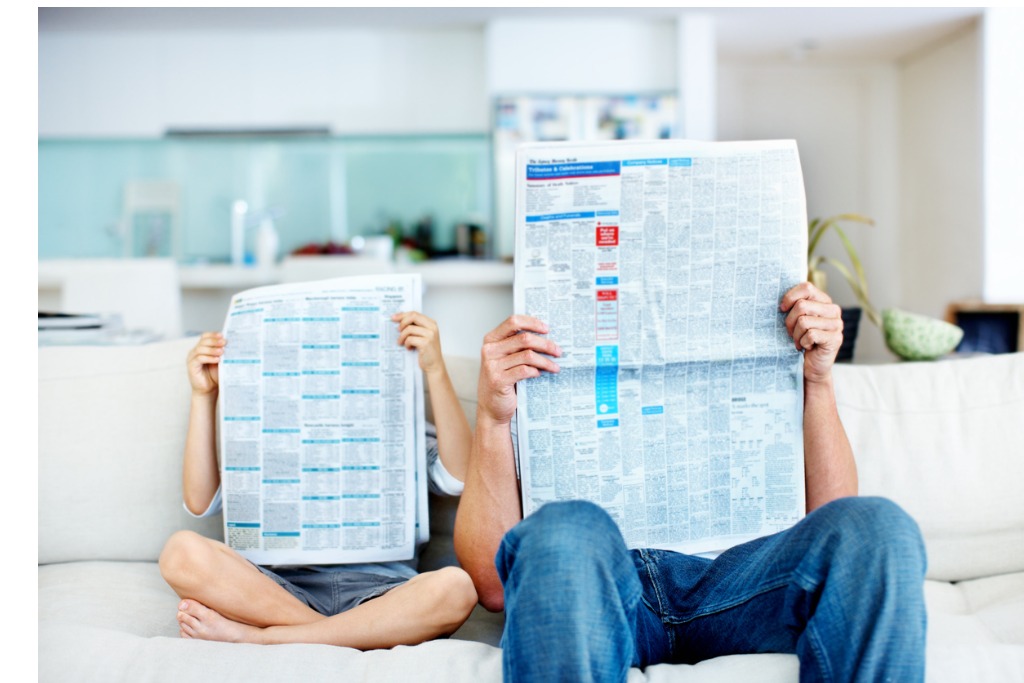
There’s no denying that falling circulations, the implementation of GDPR and the rise in digital opportunities have had an impact on printed advertising. It may be the days in which magazines and newspapers sold millions of copies per issue are no more but that doesn’t mean printed advertising is over. We’ve even heard rumours that print advertising is making a comeback…
The fact is that print advertising never went away. At AJ we’ve always been passionate about the value of print and our clients see the proof of this in their results. There has always been a place for print in the media mix. You just need to know how best to use it.
Print advertising vs Digital. Who wins?
Obviously, it depends. The debate is more nuanced than which medium is “better”. What we do know is that an environment of endless scroll and numerous screams for attention is exhausting. Online, advertisers have to fight to be heard. The battle for impressions is fierce with consumers being bombarded by messages for all angles. Print represents a return to active choice. When someone picks up a magazine, newspaper or direct mail piece they are choosing to interact with the advertising. It’s not intrusive, it invites attention instead of rudely demanding it. And believe us, consumers know and value the difference.
Digital advertising clearly has its strengths. However, even its most ardent supporters must agree that there is a world of difference between firing out an ad on social media, where you have a fraction of a seconds attention (if you are lucky) and reaching magazine readers who are relaxed, engaged and willingly absorbed in the content. Print advertising can be viewed, appreciated and pondered over, a luxury that is rarely achieved online. It’s this attention, considered and intentional that really motivates and inspires action.
Trust matters
In this sceptical world, trust is crucial. There is a clear correlation between the perceived trustworthiness of a medium and the advertising response rate.
Whether you are placing adverts into newspapers and magazines or inserts into third party mailings, a printed piece will always benefit from the implied endorsement of the publication or carrier. People know and trust the titles they read and the companies they buy from. These positive associations are then naturally transferred to the advertisers they carry. This is particularly true of affluent, older consumers who can be distrustful of many forms of digital media, and by extension, the ads on it.
Newspapers and magazines are one of the most trusted media. 2025 research by Tapestry showed that more than twice as many people trusted print ads than those they saw in social media. We see evidence of this in results, printed advertising delivers a response rate that many online options can only dream of.
Tangibility and memory advantage
The tangible nature of print intrinsically enhances its value. Afterall, who actually prefers an e-card to the real thing..?
Vogue recently reported the return of the printed beauty manual as businesses tap into a consumer desire for analogue escapism. Premium brands are increasingly seeing print as a way to differentiate themselves by producing printed marketing materials that are intentional and counteract our dwindling attention spans. Increasingly, print communications are being seen as a considered, thoughtful alternative to the avalanche of digital content available.
At its most basic, the simple act of holding a printed DM piece or turning a page is a multisensory experience. This activates deeper cognitive processing, leading to higher emotional engagement and improved recall. Numerous studies have found that people are more likely to comprehend and recall printed information compared to its digital equivalent. Print simply leaves a lasting impression that digital can never replicate.
Print advertising attracts quality, high-intent audiences.
In the UK we are lucky. Even in 2026 there is a magazine dedicated to whatever niche interest you have. This is a boon for anyone looking to target with precision. In addition, relevant context means higher engagement. And engagement means action.
We’ve also seen a shift in the quality of a print consumer. There’s no getting away from the fact that cover prices have vastly increased. Less than twenty years ago The Sun was 10p, it’s now £1.20, a rise that far outstrips inflation. The FT is now over a fiver. On average, cover prices have risen almost 200% in the past decade. What that leaves us with is a committed reader. One that will read every column inch, partly because they’ve paid for it but mainly because they truly value it.
So yes, whilst circulations have fallen, response levels have not dropped correspondingly. Advertising prices however, have seen a significant reduction helping put ROI for many clients around the same levels it always had been (or better in some cases).
The role of print advertising in a modern media mix
If you’re looking for a responsive medium that delivers an engaged audience you should never discount print. Despite all its challenges you can still get your message viewed by millions of people via printed newspapers and magazines. Direct mail opportunities allow you to send your message directly to every home in the country. If you want volume, print delivers.
Print advertising won’t be right for every campaign and it won’t necessarily meet every objective. But we’re willing to bet it will add real value to most media schedules. If you’re serious about campaign success and ROI, print should certainly be part of the conversation.
If you’d like to find out more about print advertising opportunities get in touch. We’ve got no agenda and can talk you through your options. Click here to find out more about print advertising at AJ.